




donate Donate venue Rent member Join shop Shop Visit
Kentucky Derby Museum

Education Programs

A key component of your visit will be your Museum Program. Below is detailed information on our current offerings. Keep in mind most programs can be adapted to other grade levels.

Choose a program for more info...

Racing Colors (PK/K) MATH

Program Summary
Students identify basic colors and shapes and give examples of these shapes from home, school or nature. They are shown a real jockey silk and briefly discuss what a jockey does, why silks are worn during a race and who picks out the designs. Students identify the shapes and colors on several silks. They take turns helping to create a large pretend class jockey silk. Note: You may want to bring a camera to take a picture for your classroom.

Program Goals
Students understand that we commonly use shapes and colors to communicate and identify things around us; that owners design jockey silks as a unique combination of shapes and colors. They will be able to use shapes and colors to design a jockey silk.
Core Content
MA-E-2.1.2

Horse Tales (PK/1) ARTS AND HUMANITIES

Program Summary
A storytime session at the Derby Museum using both picture books and original stories. Students will hear both familiar and interactive picture books and also an original story based on a horserace. This program was developed with the assistance of the Louisville Free Public Library and is based on accepted techniques to help students develop basic reading skills.

Program Goals
Students understand the importance and fun of reading while strengthening basic reading skills. They understand some basic elements of Thoroughbred racing.
Core Content
RD-E-1.0.10

Thoroughbred Care (K-3) SCIENCE/PRACTICAL LIVING

Program Summary
Students are asked to think about the responsibility of home pet care as they are introduced to the daily care of a Thoroughbred in training. Volunteers assist in demonstrating the washing, drying and brushing process. Basic hoof care and differences in horseshoes are shown. Volunteers are called to be a pretend horse and assistant trainer as the preparation of the horse for riding is demonstrated. The bridle and reins, shadow roll and blinkers are included. The basic diet of the racehorse is shown.

Program Goals
Students understand the importance of daily animal care both in home pet situations as well as professionally in the sport of Thoroughbred racing. They understand the basics of horse care and grooming. They can identify and explain the use of several pieces of grooming equipment.
Core Content
SC-E-3.1.2, PL-E-4.3.2

Aristides' Art Club (K-5) ARTS AND HUMANITIES

Program Summary
This program, offered in the summer, is a participatory craft experience that engages students while teaching them more about elements of Thoroughbred racing and the Kentucky Derby. Students receive either:

  • A real Thoroughbred racing plate, and then decorate it using a variety of materials including ribbon and beads. They learn about why people and horses wear shoes, and how there are different shoes for different jobs.
  • A foam visor which can then be made into a Derby hat using a variety of materials including ribbon and fun foam. They learn about how traditions make the Derby more than a horse race.
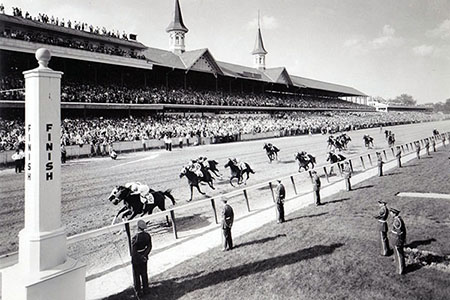
  • A foam picture frame that the students decorate. Students will learn about the importance of photography to the Kentucky Derby, including the “Fighting Finish” and the importance of the photo finish.

Program Goals
Depending on the activity selected, students understand (Derby Hats) well-known Derby traditions, or (Horseshoes) the purpose of shoes for both humans and horses. They exhibit artistic skills.
Core Content
AH-E-4.1.42

Rhythm Around the Track (1-3) ARTS AND HUMANITIES

Program Summary
Students hear samples of different styles of well-known music about horses and racing. They hear examples of everyday sounds that are musical. Using the sounds of horses walking, trotting and galloping the concepts of rhythm and tempo are introduced. Students hear examples of everyday sounds that are rhythmic. They participate in creating and singing a song about the Kentucky Derby. After a brief explanation of their use, students play in a "Derby Orchestra" using percussion instruments made from pieces of horse equipment.

Program Goals
Students understand the meaning of rhythm and tempo and are able to demonstrate their understanding through practical application. They understand the importance of and demonstrate good listening skills. They can identify and explain the use of several pieces of equine equipment.
Core Content
AH-E-1.1.22, AH-E-1.1.32, AH-E-1.2.32

Mathin' Around The Track (1-3) MATH

Program Summary
What does it take to win the Kentucky Derby?  It takes a fast horse, and a whole lot of MATH, of course!  Students will solve problems taken from the “Five Big Ideas of Math” (Number Properties and Operations, Measurement, Geometry, Probability, and Algebra) as they prepare their horse for the Kentucky Derby in this real-world application of math.

Program Goals
Students understand that math is used in day to day activities – even while preparing a horse for the Kentucky Derby.
Core Content
MA-EP-1.1.1, MA-EP-1.2.1, MA-EP-1.3.1, MA-EP-2.1.4, MA-EP-2.2.3, MA-EP-3.1.1, MA-EP-3.3.1, MA-EP-4.1.2, MA-EP-4.4.3, MA-EP-5.1.3

Creating Traditions (2-5) SOCIAL STUDIES

Program Summary
Students are introduced to the concept of traditions through a pretend birthday party. Volunteers participate in a simple "play" to better understand how traditions begin and are passed on. They attend a pretend Kentucky Derby and participate in several well-known Derby traditions, including the Garland of Roses, the singing of My Old Kentucky Home, the wearing of Derby hats and the presentation by the governor of the gold Derby trophy.

Program Goals
Students understand the concept of traditions and their place in both family and community. They recognize and describe well-known Kentucky Derby traditions. They understand that traditions make our lives more full. They can exhibit good role-playing skills.
Core Content
SS-E-2.1.1, SS-E-2.1.2, SS-E-2.2.1

Louisville and the Derby (3-12) SOCIAL STUDIES

Program Summary
This power-point presentation explores aspects of the beginnings and growth of the local community as well as Churchill Downs and the Kentucky Derby. Selected events from primarily social history are included, along with examples of African Americans involved in Thoroughbred racing. Topics briefly covered include the location and founding of Louisville, slavery in Louisville (slave jockeys, Underground Railroad), changes in transportation (horses, riverboats, various streetcars, trains, automobiles, airplanes), major natural disasters (1890 and 1974 tornadoes, 1937 flood), advances in communication (telephone, radio, newsreels, television) and the Derby and related well-known traditions.

Program Goals
Students understand the beginnings of the Kentucky Derby and significant developments throughout the history of Churchill Downs and the Kentucky Derby, as well as developments in local social history. They understand and can identify several significant forms of transportation.
Core Content
SS-E-2.4.1, SS-E-5.1.3, SS-E-5.2.3, SS-M-5.1.3, SS-H-5.1.3

Horses, Jockeys and You (4-8) SCIENCE/PRACTICAL LIVING

Program Summary
Students first consider things that keep us healthy as well as skills and requirements of being an athlete. A comparison is made of the diverse difference in the size of jockeys and horses. Interactive exercises bring out physiological aspects and body changes that occur during physical activity. Demonstrations of different pieces of equipment including safety items, explain that jockeys must be very small yet extremely strong. Diet, nutrition, training and lifestyle issues for both athletes illustrate the need for good health. A concluding role-playing activity demonstrates how these two athletes and the people who help them work together as a team to succeed.

Program Goals
Students understand Thoroughbred horses and jockeys in athletic terms, including team aspects. They can identify and explain several pieces of basic horse racing equipment. They can relate good nutrition and training habits to their own lifestyles. They understand some basic equine physiology.
Core Content
SC-E-3.1.2, MA-E-2.1.5, Pl-E-1.3.1, PL-E-1.3.4, PL-E-1.4.1, PL-E-1.5.1, PL-E-1.6.2, PL-E-2.3.2, PL-E-4.1.2, PL-E-4.4.3, SC-M-3.1.1, SC-M-3.2.3, PL-M-1.5.1, PL-M-1.5.2, PL-M-1.6.3, PL-M-2.3.2, PL-M-4.2.2, PL-M-4.4.3, PL-H-1.6.2, PL-H-4.4.3

Economics and the Derby (4-8) SOCIAL STUDIES

Program Summary
Students see examples of items that have been used as "money" in other cultures to establish money as a representation of value. The difference between needs and wants, the concept of scarcity and the balance of supply and demand are established. Students observe and participate in hands-on demonstrations of making a buying decision, how the value of an item can diminish, and how money comes into a community and passes through many different hands. The economic impact of the Kentucky Derby on the local economy is then illustrated through a pie chart and a bar graph.

Program Goals
Students understand and can demonstrate money as a symbol of value, the dynamics of making buying decisions, the changing value of items and how money circulates throughout a local economy. They understand the economic impact of the Kentucky Derby on the local economy.
Core Content
SS-E-3.1.1, SS-E-3.1.2, SS-E-3.1.3, SS-E-3.3.1, SS-E-3.3.2, SS-E-3.4.1, SS-M-3.1.1, SS-M-3.1.2, SS-M-3.3.1, SS-M-3.3.2, SS-M-3.4.3, SS-H-3.1.1, SS-H-3.1.3

Odds in Everyday Life (4-8) MATH

Program Summary
Students observe and participate in activities which demonstrate how probabilities are used in everyday problem solving. The program begins with several "real-life" examples to demonstrate using math to solve problems. The concept of ratios is briefly discussed and shown, and related to the idea of probabilities. Volunteers conduct simple experiments while the group discusses how we also used past history to determine probabilities. Sampling is defined and then demonstrated through a simple polling exercise. A discussion of how horse races are started involves the concept of perimeter and leads to the random drawing for starting positions. A simulation of the post position draw, or pill-pull, based on the real draw done during Derby week illustrates the impact of probability on the Derby. Students submit names for their Derby horses and participate in conducting the pill-pull.

Program Goals
Students understand that probabilities can often be used in everyday problem solving. They understand structuring a situation in terms of ratios, and can then apply the use of probabilities in a variety of real-world applications. They understand the process for selecting the post-positions for horses in the Kentucky Derby.
Core Content
MA-E-3.1.3, MA-E-3.2.7, MA-E-3.3.2, MA-M-3.2.5, MA-M-3.3.4, MA-H-3.2.4

Science on the Track (4-8) SCIENCE

Program Summary
Students consider basic landforms as they relate to the absolute and relative location of a new racetrack, as well as other factors that would go into the decision making for constructing a new facility. An interactive role-playing activity explains the physical and chemical weathering process of reducing rock into sedimentary material. Properties of sand, silt and clay are explored in relation to how they are used to construct a safe, consistent racing surface. A look at basic elements of track maintenance leads to the impact of weather on the racetrack and how it might affect the ability of the horses to run.

Program Goals
Students understand basic differences in silt, sand and clay and how rock is weathered and eroded to form these particles. They can apply knowledge to building and maintaining a racetrack. They understand how and why weather affects a racetrack. They can identify various landforms and determine how they affect the location of a racetrack.
Core Content
SC-E-2.1.1, SC-E-2.3.1, SS-E-4.1.4, SS-E-4.4.4, SC-M-2.1.2, SC-M-2.1.4, SC-M-2.1.5, SS-M-4.1.2, SS-M-4.4.1, SS-H-4.1.3

Culture and Racing (4-8) SOCIAL STUDIES

Program Summary
Students are asked to define culture, and to consider elements that are part of their culture, including fads and trends. They see images to encourage discussion about cultural universals and differences in culture around the world as well as changes in our culture over time. They participate in short activities that will demonstrate the challenges of moving from one culture to another. A final activity provides connections to Thoroughbred racing in cultures in the Americas, Africa, Europe, Australia and Asia, both contemporary and historic. The connection to the Kentucky breeding industry is made.

Program Goals
Students will understand culture as a part of society and that there are similarities as well as differences in cultures around the world. They will gain insights into the challenges of moving between cultures. They will understand that Thoroughbred racing is a world-wide sport with historical and contemporary connections to many different cultures around the world, and why this is important to the Kentucky breeding industry.
Core Content
SS-04-2.1.1, SS-05-2.1.1, SS-05-5.2.4, SS-06-2.1.1, SS-06-2.2.1, SS-07-2.1.1, SS-07-2.2.1, SS-08-2.1.1, SS-H-2.2.1

Race Through Time (4-8) SOCIAL STUDIES

Program Summary
This fast-paced, interactive activity tells the story of Thoroughbred racing and its place in American social history from the early Colonial period through the late 19th Century. Existing knowledge of important people and events is used to provide context for new figures introduced. Elements briefly covered include:

  • Horse care in West African kingdoms
  • Origins of the Age of Exploration
  • American colonization and racing in early America
  • Growth of the African slave trade and the rise of jockeys
  • Origins of the Epsom Oaks and Derby in England
  • Impact of the Civil War on Kentucky racing and the origins of the Derby
  • African American jockeys in early Kentucky Derbys

Program Goals
Students understand the place of Thoroughbred racing in U.S. social history, including key roles played by African Americans. They understand the concept of a "skilled slave". They understand reasons for and the process involved in the beginning of the Derby and Churchill Downs. They can incorporate this information with existing knowledge.
Core Content
SS-E-2.4.1/5.1.3/5.2.3, SS-M-5.1.3/5.2.1/5.3.5, SS-H-5.1.3

African Americans in Thoroughbred Racing (4-12) SOCIAL STUDIES

Program Summary
Students think about modern sports and athletes and their starring roles in our society. The idea of slave jockeys as some of America's earliest athletes is introduced. Students view a PowerPoint presentation and hear about great West African kingdoms, and the importance of horses and those who cared for them in African culture. This heritage of horsemanship is connected through the West African slave trade to Colonial America. An example of a slave auction shows how skills determined the value of a slave. The idea of jockeys is established, with owners in the South turning to slaves. The accomplishments of slave jockeys are explored, leading up to the Civil War and the beginnings of the Derby. Students "meet" several early successful African American Derby jockeys, with a focus on Isaac Murphy and Jimmy Winkfield. African American trainers and later owners are also shown. A look at some modern African American horsemen concludes the program.

Program Goals
Students understand the role that African Americans played and can recognize some of their accomplishments in the sport of Thoroughbred racing from early Colonial times to the present. They are aware of key individuals in this story.
Core Content
SS-E-2.4.1, SS-E-5.2.3, SS-E-5.1.3, SS-M-2.4.1, SS-M-5.1.3, SS-M-5.3.5, SS-H-2.4.1, SS-H-5.1.3

Workouts Tour (4-12) SCIENCE/PRACTICAL LIVING

Program not available from mid-December to early March (racetrack closed for training).

Program Summary
This program is conducted track-side during the morning training and thus responds to the real-life activity of training Thoroughbreds that the students observe; each program is unique. Students may expect to see and/or discuss:

  • The roles of the trainer, groom, hotwalker and exercise rider in the training process.
  • The various training activities that Thoroughbreds undergo and the purpose of each.
  • Selected equipment used with Thoroughbreds and by the exercise riders.
  • An overview and brief history of the Churchill Downs facility including details about the running of the Kentucky Derby.

Program Goals
Students understand the process of training Thoroughbred horses.
Core Content
PL-E-4.1.2, PL-E-4.4.3, SC-M-3.2.1, SC-M-3.2.3, SC-H-3.2.2

Vanishing Bluegrass (4-8) SOCIAL STUDIES

Program Summary
Population growth, land development and suburban sprawl are issues that affect communities across America. In Kentucky, the Bluegrass Region is being threatened as more and more of its farmland is being developed prompting the World Monument Fund to include this region on its list of 100 most endangered sites. This interactive program explores the early days of the Bluegrass Region, as Thoroughbred farms became established and flourished. Three historic Thoroughbred farms will be “visited” as students see the effects of suburban sprawl and land development. Students will participate in activities that show that changes are taking place all around them – in their communities, neighborhoods and even schools; and they have a voice in what they want their community to look like.

Program Goals
Students understand the importance of the Thoroughbred industry in Kentucky. They learn the origins, as well as some of the great farms that are an integral part of the cultural and economic landscape of the Bluegrass Region. The effects of the Civil War are explored, as well as the current issue of suburban sprawl and land-use issues most communities in Kentucky are dealing with.
Core Content
SS-06-4.1.2, SS-06-4.3.2, SS-06-4.4.3, SS-05-4.4.3

Jockeying for Positions (9-12) SOCIAL STUDIES

Program Summary
This program will teach students about the history, culture, and status of the horse industry in Kentucky.  We will discuss how horse racing and the Derby began, and then we will explore the various cultures that have impacted the sport.  We will talk about the economic impact of the Derby on the city of Louisville and the Kentuckiana region, and also discuss the career opportunities involved.  These part-time and full-time jobs require a wide range of skills, learning, and values which the students will understand.

Program Goals
The goal is to introduce students to the range of careers available in one industry, and also to stress the importance of training, learning, and gaining related experience.
Core Content
2.16, 2.19, 4.5, SS-M-2.4.1, SS-M-5.1.3, SS-M-5.3.5, SS-M-3.4.3, PL-E-4.1.2, PL-E-4.4.3, PL-HS-4.1.3, PL-HS-4.1.7, PL-HS-4.2.1, PL-HS-4.2.2

Looking for a great venue for a wedding or corporate event in Louisville, KY? Learn more >>

Finish Line Giftshop